

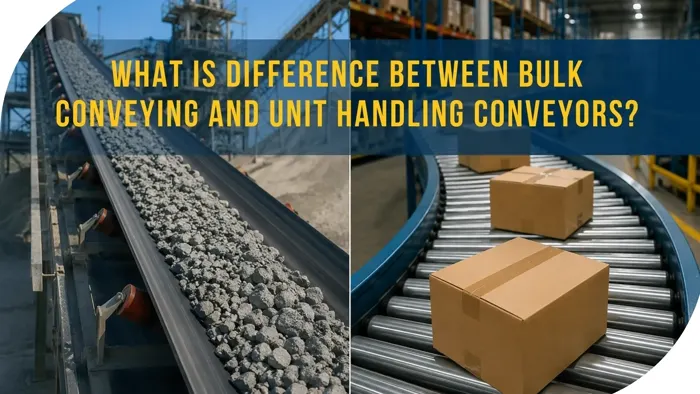
What is difference between Bulk Conveying and Unit Handling Conveyors?
Welcome to Excel Conveyors
Welcome to Excel Conveyors, a leading manufacturer of Conveyor and Conveyor Roller in India. We manufacture cutting-edge industrial conveyor systems and provide customized solutions for your unique material handling needs. Our extensive range includes belt conveyor systems, automated conveyor systems, and flexible conveyors that enhance efficiency and streamline operations.
As an idler roller manufacturer and conveyor equipment supplier, we deliver reliable products that support productivity across various industries. Established with a vision in 2016, Excel Conveyors stands for trust, reliability, and a commitment to delivering custom conveyor solutions that meet your business requirements.
What is Bulk Conveying?
Bulk conveying moves large volumes of loose materials — such as grain, sand, cement, ore, or coal — where the material itself is the unit being transported. Bulk handling systems are optimized for continuous flow, typically using conveyors such as screw conveyors, belt conveyors (for bulk), drag chain conveyors, or pneumatic conveying, depending on the material characteristics.
What are Unit Handling Conveyors?
Unit handling conveyors move discrete packages, cartons, pallets, or parts where each item is a separate load. Examples include roller conveyors, belt conveyors for packaged goods, accumulation conveyors, and automated guided vehicle (AGV) systems integrated with conveyors for piece flow.
Key Differences
- Product Type: Bulk conveying handles loose, granular or powdered materials; unit handling deals with discrete items or packages.
- Conveying Media: Bulk systems often use enclosed belts, screws, chains, or pneumatic lines; unit handling commonly uses rollers, flat belts, or modular conveyors.
- Flow: Bulk conveying is continuous and volumetric; unit handling is intermittent and item-based, allowing accumulation and routing.
- Controls & Automation: Unit handling usually requires more complex controls for sorting, accumulation, indexing and integration with pick-and-place systems. Bulk systems focus on feed rates, dust control and material conditioning.
- Accuracy & Damage Risk: Unit handling requires gentler handling and positional accuracy for packaging and assembly; bulk conveying must avoid degradation/segregation of material.
- Applications: Bulk conveying dominates mining, cement, agriculture and chemicals; unit handling is common in logistics, e-commerce, food packing, and assembly lines.
- Design Priorities: Bulk systems prioritize capacity, abrasion resistance, and sealing; unit systems prioritize reliability, indexing, and throughput for discrete items.
When to Choose Which?
Choose bulk conveying when you need to move large quantities of loose material continuously and the product can tolerate bulk handling. Choose unit handling conveyors when you must transport individual items, perform sorting, accumulation, or integrate with downstream packaging and robotic systems.
Contact & Support
If you need help selecting the right system for your application, contact our team. We design customized solutions to match throughput, footprint, and product handling requirements.
- Excel Conveyors
- Gat No 1551, Near Gagangiri Foods, Sonawane Vasti, Chikhali, Pune 411062 India
- Email: sales@econveyors.in
- Call: +91 98229 57645