
How to Design & Calculate Roller Pitch for Chain Driven Live Roller Conveyors
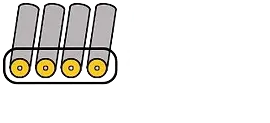
Chain driven live roller conveyors are used to move products such as carton boxes, plastic crates, and totes at controlled speeds. These conveyors benefit from positive engagement between the chain and chain teeth, delivering excellent power transmission for heavy-duty loads.
A common complaint about chain-driven roller conveyors is noise. The key to minimizing this lies in proper roller pitch calculation during the design phase. Noise typically results from improper engagement between chain and sprocket, which occurs due to miscalculations of roller pitch.
Understanding Sprocket & Chain Engagement
Most of us have adjusted chain tension on a bicycle during childhood. We do this when the chain frequently slips off the sprocket or produces noise. When you adjust bicycle chain tension, you're managing the distance between chain teeth for proper engagement. This is done by either reducing or increasing the distance between two sprockets.
Key Concept: Any chain has a pitch. If a chain is a 4" chain, it means that when a sprocket moves by 1 tooth, the chain moves by 4".
For reference: 4" = 4 inches = 4 × 25.4 = 101.6 mm
Understanding Roller Chain Calculation for Pitch Consideration
Below are the sprocket pitches generally used for conveyor rollers:
- 3/8" = 3/8 inch = 3/8 × 25.4 = 9.52 mm
- 1/2" = 1/2 inch = 1/2 × 25.4 = 12.7 mm
- 5/8" = 5/8 inch = 5/8 × 25.4 = 15.87 mm
For roller conveyors, chain is transferred from one roller to another. Since there's no room for tensioning (as it would disturb adjacent pairs), the best approach is to maintain optimum distance during design, eliminating the need for tensioning.
Practical Example
Let's consider an example: You need to carry a carton box with dimensions 400 mm length × 350 mm width, weighing 50 kg.
- For stability: 4 rollers should support any product at any time
- Roller pitch calculation: 400 mm ÷ 4 = 100 mm
- Load per roller: 50 kg ÷ 4 = 12.5 kg
- Each roller capacity: Must support 12.5 kg minimum
For this scenario, we select a roller with 50.8mm diameter paired with a 1/2" × 14 teeth sprocket. The chain pitch is 1/2 inch (12.7 mm).
Ideal pitch calculation: 12.7 × 8 = 101.6 mm
Roller Chain Assembly for Roller Conveyors
If you maintain a pitch of 101.6 mm exactly, it becomes difficult to install the chain lock and join the chain together. To simplify installation, you can adjust the pitch slightly:
- Use full lock chains with even pitches (e.g., 101.0 mm, 101.3 mm)
- Use half lock chains with odd pitches (e.g., 12.7 × 7.5 = 95.25 mm)
All chains come with two types of locks:
- Full Lock: Used for even pitch calculations
- Half Lock: Used for odd pitch calculations, providing flexibility in design
Watch the video below showing a conveyor running at 50 meters/minute with the original chain sound:
By following these principles of roller pitch calculation, you can design chain-driven roller conveyors that operate smoothly with minimal noise while maintaining optimal load distribution and product stability.