
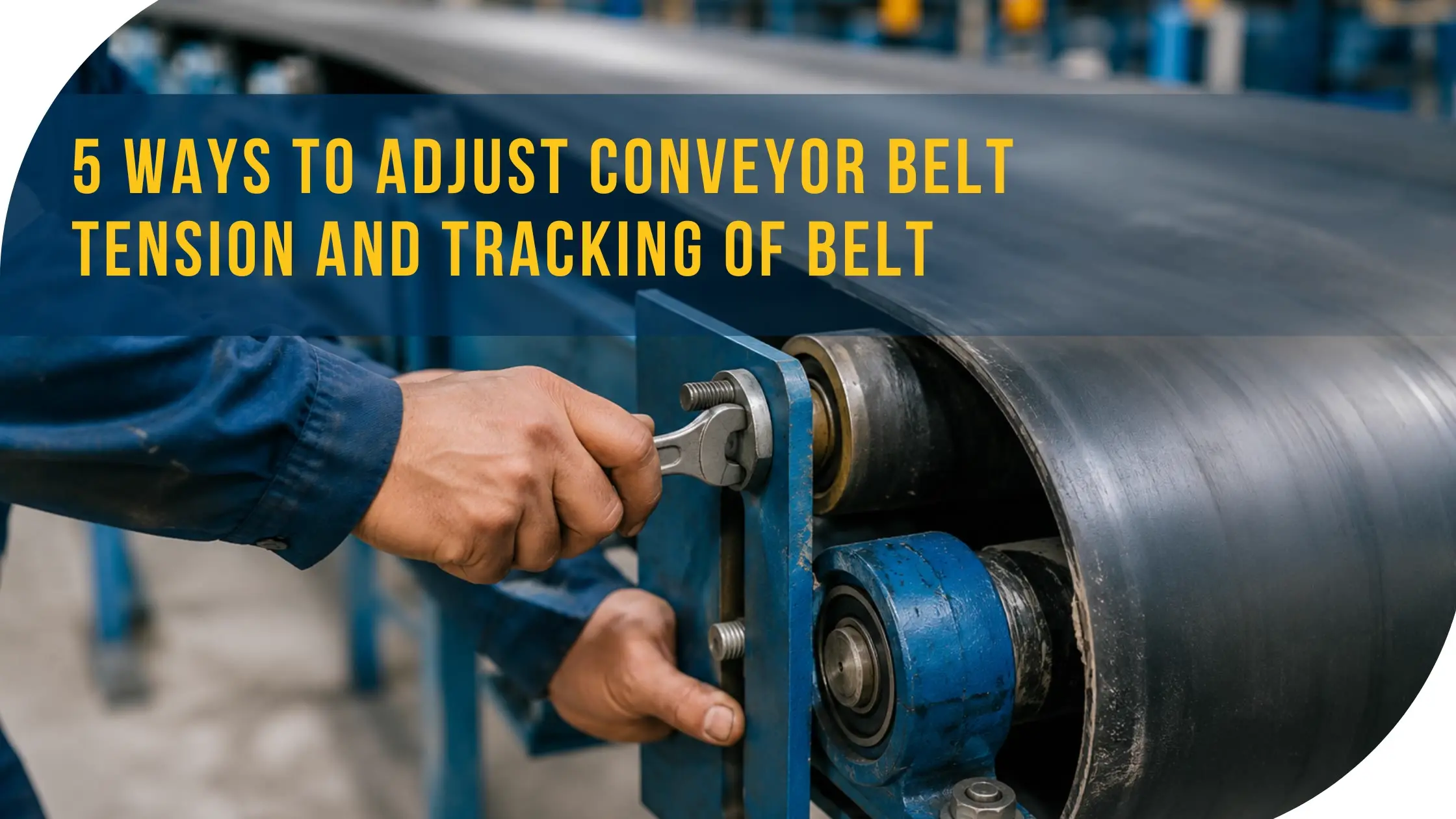
5 Ways to Adjust Conveyor Belt Tension and Tracking of Belt
Tracking of Belt Conveyors
Belt Tracking is often an issue faced by conveyor manufacturers and users. Maintenance people are called frequently for belt tracking problems in production areas.
Below are the steps by which should be followed while tracking the belt.
Below you shall find the procedure to track the belt. One should understand the science behind belt untracking. Conveyor belt is cut square (rectangle) while joining. When the belt is trying to come to its origin, i.e., squareness, it leaves its position and it gets out of the track.
The elements of the belt conveyors need to be properly at 90 degrees to each other such as the support frame, the drive & driven rollers, and support rollers.
When we are adjusting the belt tension, we are only trying to maintain the squareness of the belt.
One should follow each step carefully with the technical understanding of the same. You should provide sufficient time for the belt to take its position after each adjustment. Do make small changes, allow the belt to move, observe the position and decide the next action.
Steps to Track your Conveyor Belt and Adjust Tension
Check Runout or Concentricity of the Drive/Driven Roller
Runout or concentricity of the drive/driven rollers is the most common cause of belt getting off track. Follow these important checks:
- Roller Alignment: Check the drive & driven rollers position to ensure they are exactly at the right angle to the belt. Basically, if you join the center lines a perfect square should be formed. Conveyor support structure may be welded or aluminum profile welded—in any case, it is necessary that it forms a perfect square.
- Support Roller Position: Check that support rollers are exactly at the right angle to the belt top. The support rollers may force a change in the position.
- Foreign Material: Check if any foreign material is stuck below the belt, such as carton box cut pieces, metal debris, electrical wires, screws, or nuts.
- Belt Quality: Check if the belt is properly cut with a perfect square cut, as improper cuts contribute to tracking issues.
5 Ways to Track Your Conveyor Belt
1. Rubberizing the Rollers
How it works: Rubberizing the rollers is an easy solution if it is possible. Rubber increases grip between the rollers and the belt and avoids belt movement. This method is cost-effective and provides immediate improvement in belt tracking stability.
2. Knurling and Crowning of the Rollers
How it works: Knurling and crowning of the rollers increases grip on the rollers and is also a good way to maintain the belt in place. This mechanical modification creates better contact between the roller surface and the belt, preventing slippage and lateral drift.
Design Considerations for Belt Conveyors
It is always advisable to take extra care during the design phase so that belt tracking issues can be avoided from the beginning. With the advancement of technology, there are several ways to avoid and minimize belt tracking issues:
- Coating of the Drive Roller: Applying specialized coatings to the drive roller improves traction and reduces belt slippage, contributing to better belt tracking.
- Crowning of the Drive Roller: Crown-shaped roller profile guides the belt to the center, naturally maintaining proper alignment throughout operation.
- Knurling of the Drive Rollers: The knurled surface pattern provides enhanced grip and mechanical control of belt position.
- Centre Guide for the Belts: Installing center guides acts as a physical boundary, preventing excessive lateral belt movement and maintaining consistent positioning.
Key Takeaways
Effective belt tracking and tension adjustment require a systematic approach combining proper diagnosis with proven solutions. Understanding the root causes—such as roller misalignment and concentricity issues—enables targeted corrections. Whether implementing mechanical solutions like rubberizing and knurling or optimizing the design with crowning and center guides, the goal remains the same: maintaining belt squareness for smooth, efficient conveyor operation.
Regular maintenance, careful observation, and adherence to proper procedures will significantly reduce belt tracking problems and extend conveyor system lifespan.